Research

Publications
A selection of publications highlighting the conclusive evidence of ozone as a decontaminant, in a variety of healthcare and other applications.
| ||||
| ||||
| ||||
|


Research by

Laboratory Test 1
Institute for Medical Research
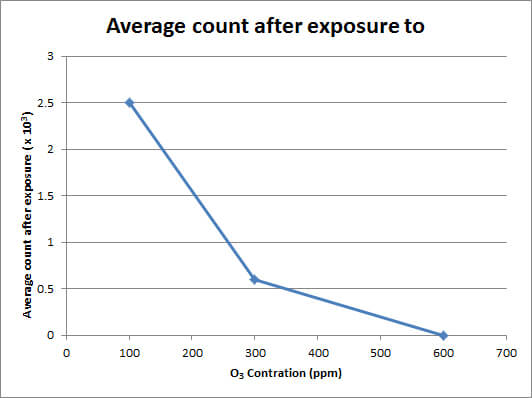
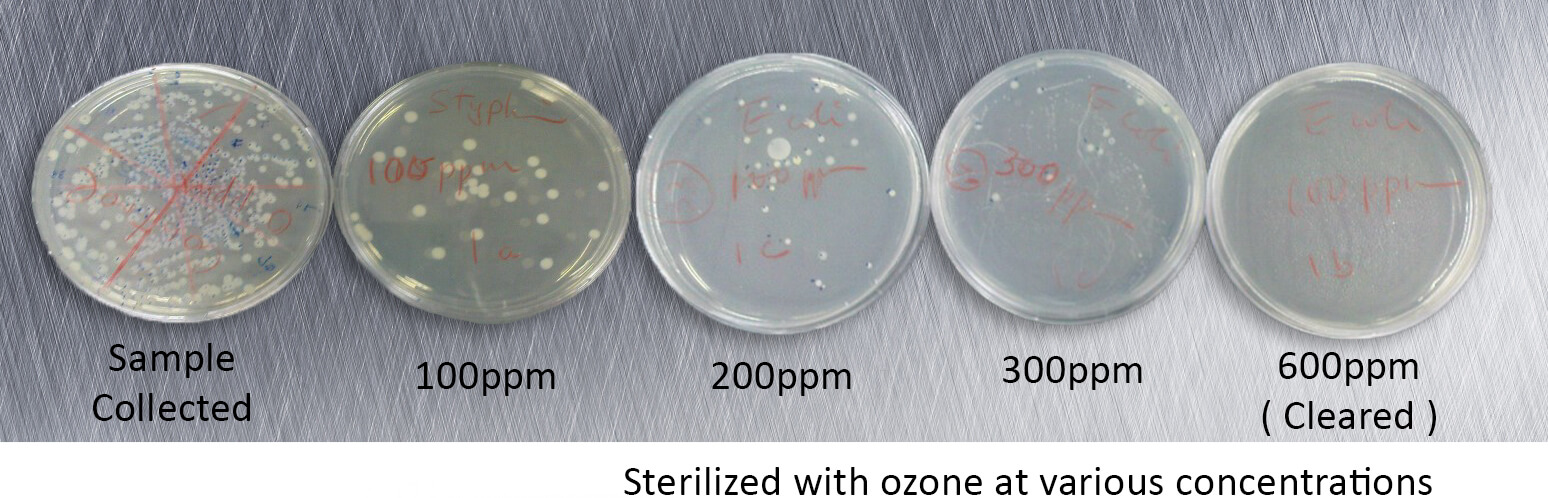
 At 600ppm of Trioxide fumigation, left no detectable microorganism remaining. We concluded that microorganisms were thoroughly eliminated.
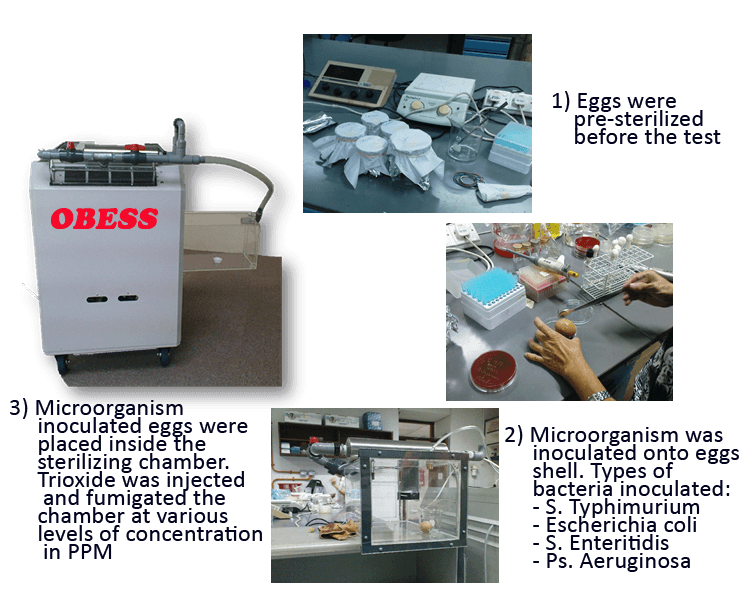
Procedure
Laboratory Test 2
Faculty of Medicine and Health Science

- ProcedureLevel 1
– At the sterilizing chamber before the filter
– Determine external air quality before sterilization
Level 2
– At the sterilizing chamber after the filter
– Determine the effectiveness of OBESS after sterilization
Level 3 ( External Air Quality Check Point)
– At the neutralizing chamber mixing of external air
– Determine external air quality after sterilization- Collect Air Sample at all levels for 10 minutes & 60 minutes.
(To determine the amount of microorganisms in the air for comparison purpose) - Treatment started after collection of air sample had completed.
- Retake air sample at L3 at last 10 min before sterilization cycle process complete. (To determine External Air Quality)
- Collect Air Sample at all levels for 10 minutes & 60 minutes.
- Operationsa. Extract contaminated air for 10 min or 60 min as sampling volume
b. Extract contaminated air for 60 min /120min /180 min /240min (different day) for sterilizing treatment.
c. Sterilize the extracted air by Trioxide gas at 8,800ppm for 10 min.
d. Retrieved Trioxide gas and convert to Oxygen at the end of the output. - Microbial Analysis Methoda. Aerobic cultivation (incubation) within 3 days at 37°C.
b. Fungus incubation within 5 days at 30°C.
c. Total plate count by colony forming unit (cfu/plate). (Colony Forming Unit)
Results
- All microorganism were diminished at level 1, the sterilizing chamber.
- At level 2, indicated that microorganism were successfully eliminated at sterilizing chamber.
- At level 3, indicated that the external air was still filled with microorganism and needed to be carried out further sterilizing process.

Fully Funded and Monitored by the Malaysian Ministry of Science, Technology and Information
OBESSTM
Our innovation in infection control technology has state approval because of its safety, simplicity, and rapid decontamination procedure for both enclosed and open areas – making it specifically suitable for the healthcare market.
MOSTI heralded the OBESS Sterilization System as breakthrough – making hospital environments safer for patients, free of cross-contamination.